 English
 Português
 русский
 Español
News ·
News ·
News ·
News ·
News ·
News ·
News ·
News ·
News ·
News ·
News ·
News ·
News ·
News ·
News ·
News ·

About us
Our team is proud to offer on time guarantee and product guarantee to customer satisfaction.
Read Morecontact info
- No.186 Xianglong Road, Lishui City, 323000 Zhejiang, China
- +86-13666550158
- lydia@wangong.net
Posted by Wangong
Why Do Ball Screw Types Affect Machine Accuracy in Motion?
Linear motion systems that fail to hold positional accuracy under load create compounding problems across a production line — dimensional errors in machined parts, inconsistent press force, misaligned assembly operations. Engineers who have traced these problems back to the transmission component know that the screw driving the axis is not where people initially look, yet it often proves a significant place to examine. Ball screw types differ in ways that directly affect backlash, rigidity, load capacity, and the ability to sustain accuracy over high cycle counts — and understanding those differences changes how a motion system gets specified from the design stage rather than corrected after failure.
The Mechanical Basis of Ball Screw Accuracy
Rolling Contact Is What Separates Ball Screws From Sliding Alternatives
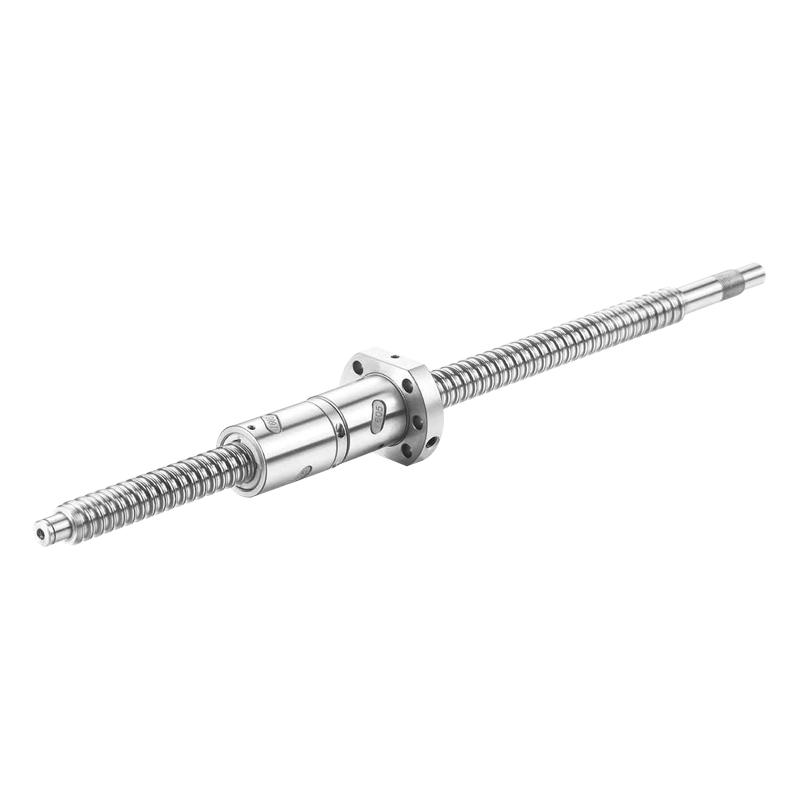
A ball screw converts rotary motion into linear motion through a precisely threaded shaft and a corresponding nut. What distinguishes it from a conventional sliding-contact screw is the recirculating steel balls positioned between the shaft thread and the nut thread. These balls roll rather than slide, which reduces friction dramatically and eliminates the stick-slip behavior that causes positional inconsistency in sliding-contact mechanisms.
The practical consequences of this rolling contact:
- Friction coefficients are substantially lower than in sliding screw systems, which means drive force is transmitted more efficiently
- Repeatability improves because the motion characteristic is consistent rather than variable with changing surface conditions
- Backlash — the dead zone of motion where input rotation produces no output displacement — is controllable through preloading rather than inherent in the contact geometry
- Heat generation under sustained operation is reduced, which matters for thermal stability in precision equipment
This is the foundational reason that ball screws appear in CNC machining centers, semiconductor handling equipment, robotics, and any other application where positioning accuracy is a functional requirement rather than a preference.
Understanding the Primary Ball Screw Types
Ground Ball Screws Achieve Tighter Lead Accuracy Through Post-Process Finishing
A ground ball screw is manufactured by thread grinding after the initial machining operations. The grinding process removes small amounts of material to bring the thread form and pitch accuracy to a level that cannot be achieved by rolling or cutting alone. The result is a screw with tighter accuracy in the correspondence between input rotation and output linear displacement across the entire shaft length.
Ground screws are grouped into precision grades, each corresponding to an allowable error in the translation from rotation to linear displacement over specified lengths. Higher-grade ground screws carry smaller allowable errors, which directly translates to tighter positional accuracy in the motion axis. Applications in precision measurement equipment, semiconductor lithography stages, and high-accuracy CNC machining typically require ground screws to maintain the repeatability the operation demands.
The trade-off is cost. Grinding operations add time and consumable tooling to the manufacturing process, which is reflected in the price relative to rolled screws of comparable dimensions.
Rolled Ball Screws Offer Cost Efficiency With Adequate Precision for Many Applications
In a rolled ball screw, the thread form is produced by pressing the material rather than removing it. Cold-forming the thread work-hardens the surface, which improves wear resistance at the thread contact surface. Lead accuracy in rolled screws is lower than in ground equivalents, but for many applications — general industrial automation, material handling, non-precision positioning systems — the accuracy level of a rolled screw is entirely adequate.
Rolled screws are also available in precision grades, though the ceiling is lower than for ground screws. For applications where the system requirement sits within rolled-screw capability, specifying a rolled screw delivers cost savings without compromising functional performance.
High Speed Ball Screws and Their Design Characteristics
Speed Is Not Just About Maximum Rotational Rate — It Involves Vibration and Thermal Management
An industrial ball screw used in high-speed applications needs to manage dynamic behavior that becomes significant as rotational speed increases. At high speeds, the ball recirculation system must handle the momentum of the balls as they circulate through the return path. Vibration, noise, and heat generation all increase with speed, and these effects compound over long, slender screws where the critical speed — the rotational speed at which shaft resonance occurs — may be reached before the desired operating speed.
A high speed ball screw is designed with attention to several specific factors:
- Optimized ball recirculation paths that reduce impact and noise as balls transfer from the loaded to the return circuit
- Reduced ball contact angle in some designs, which lowers friction heat generation at high rotational speeds
- Shaft support configurations that raise the critical speed, allowing faster operation without resonance
- Surface finish quality on the thread and ball contact surfaces, which directly affects rolling smoothness and heat generation at speed
High-speed applications in machining, pick-and-place systems, and medical device manufacturing use these screws where throughput is as important as accuracy and the two requirements coexist in the system specification.
Heavy Duty Ball Screws and Load Capacity Engineering
Load Capacity Depends on Contact Geometry, Ball Size, and Nut Design
A heavy duty ball screw is engineered to handle sustained axial forces well above what a standard screw of equivalent diameter would support. The design variables that determine load capacity include the ball diameter relative to the groove radius, the number of loaded turns in the nut, the helix angle of the thread, and the material and heat treatment of both shaft and nut.
Key design features in heavy-duty configurations:
- Larger ball diameter relative to the thread pitch increases contact area, which distributes load over more material
- Multiple start threads in some designs allow a higher number of loaded balls in the circuit simultaneously, raising the dynamic load rating
- Flanged or extended nut bodies with more loaded turns provide additional load-carrying capacity without increasing shaft diameter
- Higher material hardness and controlled case depth in the thread surface improve fatigue resistance under repeated loading
Heavy duty ball screws are used in press applications, injection mold actuators, industrial clamping systems, and any axis that carries substantial workpiece or fixture weight while maintaining positional accuracy.
Preload and Its Effect on Backlash
Eliminating Backlash Requires Controlled Preload Between the Nut and Shaft
Backlash in a ball screw system is the small amount of lost motion that occurs when the direction of travel reverses. In a non-preloaded screw, there is a clearance between the ball contact surfaces in the loaded direction and the return direction, which means input rotation does not immediately produce output displacement when the drive reverses. In a precision axis, this lost motion appears as a positional error every time direction changes — which is a fundamental limitation for contouring, drilling, or any operation that requires accurate reversing behavior.
Preload eliminates this by placing the balls under a compressive load between the nut and shaft at all times. The balls are slightly oversized relative to the groove clearance, or the nut is split into two halves offset axially to create opposing contact forces. Either way, there is always a positive contact force in both directions of travel, and reversal produces immediate motion without a dead band.
Preload level involves a trade-off:
Higher preload reduces backlash and increases system stiffness, which improves accuracy under varying loads
Higher preload also increases friction, heat generation, and wear rate — reducing efficiency and potentially shortening service life
Light preload is appropriate where backlash requirements are modest and efficiency is a concern
Heavy preload is justified in applications requiring zero backlash under high load variations, such as machining applications with significant cutting force variation
Lead Screw and Ball Screw Difference: Where Each Technology Belongs
The Choice Between These Two Technologies Reflects Fundamentally Different System Requirements
Knowing how a conventional screw (with sliding contact between thread and nut) differs from a ball screw is relevant for engineers specifying new systems or evaluating existing designs. A conventional screw of this kind is simpler, costs less, and self-locks in many configurations. It suits applications where positioning accuracy requirements are modest, speeds are low, and the self-locking behavior is a safety or operational advantage.
Ball screws give up the self-locking characteristic to gain efficiency and accuracy:
- Efficiency in a ball screw is noticeably above that of a sliding conventional screw, meaning less motor torque is needed to move the same load.
- Back-drivability — the ability of an axial load to rotate the shaft — is present in ball screws and requires brake systems or motor holding torque in vertical axes.
- Accuracy in translation from rotation to linear displacement in a precision ball screw is better than in a comparable conventional screw by a clear margin.
- Backlash control through preload is available in ball screws; backlash compensation in a conventional screw is typically handled through spring-loaded double nuts, which adds complexity.
For high-cycle industrial automation, CNC machining, and precision positioning, the efficiency and accuracy of ball screws justify the added cost and the need to manage back-drivability. For simple, slow, or infrequent motion where self-locking is an advantage, conventional screws remain a suitable choice.
A Comparison of Ball Screw Types Across Key Performance Dimensions
How different configurations compare across the specifications relevant to industrial motion system design:
| Ball Screw Type | Lead Accuracy | Speed Capability | Load Capacity | Backlash Control | Typical Application |
|---|---|---|---|---|---|
| Ground precision screw | High | Moderate to high | Standard | Via preload | CNC machining, precision instruments |
| Rolled standard screw | Moderate | Moderate | Standard | Via preload | General automation, material handling |
| High speed ball screw | Moderate to high | High | Standard | Via preload | Pick-and-place, rapid traverse axes |
| Heavy duty ball screw | Moderate | Moderate | High | Via preload | Press systems, heavy load positioning |
| Miniature precision screw | High | Low to moderate | Low | Via preload | Medical devices, semiconductor handling |
| Large diameter industrial screw | Moderate | Low to moderate | Very high | Via preload | Industrial presses, large machine tools |
No single configuration dominates across all dimensions. A high-speed screw optimized for rapid traversal may have a lower load rating than a heavy-duty screw at the same shaft diameter. A ground precision screw may not be rated for the rotational speeds of a high-speed application. System design requires matching the screw type to the specific combination of accuracy, speed, and load that the application demands.
How Recirculation Design Affects Motion Smoothness
The Path Balls Travel Through the Nut Affects Noise, Vibration, and Accuracy
Ball recirculation — the mechanism that returns balls from the loaded zone back to the entry point of the nut — is a structural detail that significantly affects operational smoothness. Poor recirculation design creates impact events as balls re-enter the loaded zone, which produces vibration and noise and can degrade positional accuracy at the microscale through mechanical excitation.
Common recirculation designs:
End-cap return: Balls exit from the end of the nut through a curved return tube and re-enter at the other end. Compact and common in standard applications.
Internal return: Balls are deflected internally within the nut body, reducing the axial length of the return path. Associated with smoother, quieter operation in demanding applications.
Tube return: External return tubes run along the outside of the nut, accommodating larger ball circuits and higher load ratings.
In precision and high-speed applications, the recirculation design is specified together with the thread geometry — both contribute to the dynamic behavior of the axis.
Lifecycle Accuracy and Maintenance Considerations
Does Accuracy Degrade Over Time, and How Is It Managed?
It does, and the rate of degradation is affected by load, speed, lubrication, contamination, and the initial preload setting. As the thread contact surfaces and balls wear through accumulated cycles, the contact geometry changes slightly. In a preloaded screw, wear reduces the effective preload, which allows backlash to develop. In a non-preloaded screw, wear increases the clearance in the nut-shaft contact.
Factors that extend service life and slow accuracy degradation:
- Adequate lubrication maintained throughout the operating life — both grease and oil lubrication systems are used depending on the application; both degrade over time and need to be replenished
- Contamination control — particles entering the ball circuit accelerate wear on both the balls and the thread surfaces; sealing and wipers on the nut are standard in contamination-prone environments
- Operating within rated loads and speeds — overloading or over-speeding a screw compresses the fatigue life disproportionately
- Periodic inspection and preload adjustment in precision applications — as preload reduces through wear, it can be partially recovered through nut adjustment depending on the design
For industrial applications where ball screw replacement is planned as part of a maintenance program, understanding the wear-to-accuracy relationship allows replacement to be scheduled before the accuracy degradation affects part quality or system performance.
Selecting the Right Configuration for the Application
Choosing among ball screw types is a decision that belongs in the design phase, not the procurement phase. A screw selected on price or availability without confirming its accuracy grade, load rating, speed capability, and preload specification against the application requirement will create problems that appear later under operating conditions rather than during commissioning. For engineers and procurement teams sourcing industrial ball screws — whether for standard applications, high-speed axes, heavy-load systems, or custom ball screw configurations requiring specific dimensional or accuracy specifications — Lishui Wangong Precision Machinery Co., Ltd. manufactures ball screws across precision grades, diameter ranges, and nut configurations with engineering support for application matching and custom specification requirements. Reaching out to discuss your specific load, speed, accuracy, and dimensional requirements is the practical way to confirm that the screw specification will support the system performance your application demands.
keep
in touch.
in touch.
-

Address: No.186 Xianglong Road, Lishui City, 323000 Zhejiang, China
-

E-Mail: lydia@wangong.net
-

Tel: +86-13666550158
Copyright © 2026 Lishui Wangong Precision Machinery Co., Ltd.

Ball Screw Manufacturer