 English
 Português
 русский
 Español
News ·
News ·
News ·
News ·
News ·
News ·
News ·
News ·
News ·
News ·
News ·
News ·
News ·
News ·
News ·
News ·

About us
Our team is proud to offer on time guarantee and product guarantee to customer satisfaction.
Read Morecontact info
- No.186 Xianglong Road, Lishui City, 323000 Zhejiang, China
- +86-13666550158
- lydia@wangong.net
Posted by Wangong
Linear Guideway Orders: Specify Rails and Blocks as One Arrangement
A linear guideway order can contain the right rail family and still leave the machine builder without a complete motion arrangement. Rail lengths, block quantities, mounting references and supply scope need to be defined together. The engineering question is how the selected components will support and guide the intended axis, not simply which catalog series appears on the quotation.
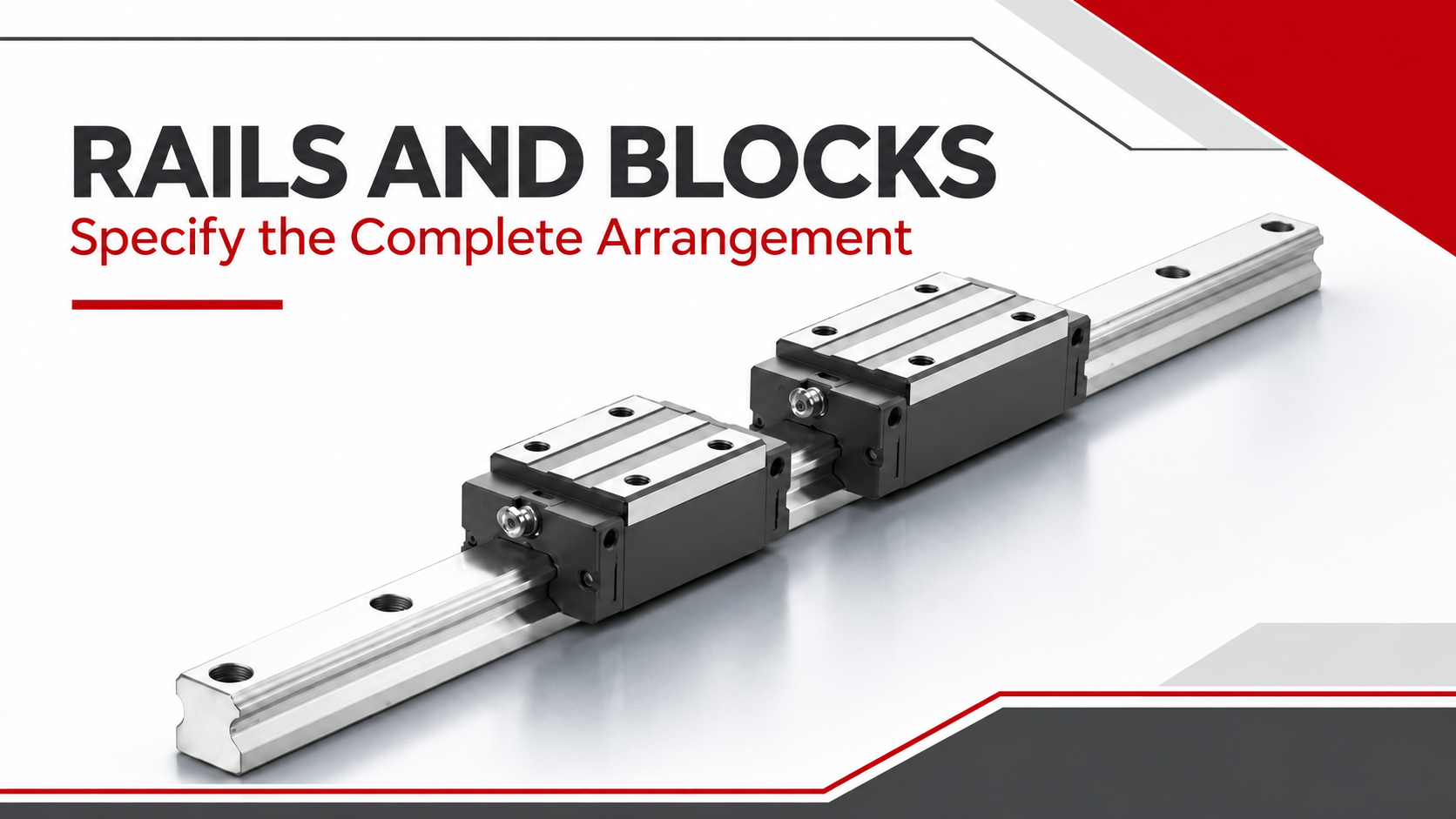
Wangong’s High Assembly HGH-CA/HA Series Linear Guideway is the product family used for this engineering review. The photograph shows a rail carrying two blocks. The order must still define the actual rail lengths, block quantities, grades and mounting references required by the machine arrangement.
Start with a view of the complete axis
The Wangong reference is the high-assembly HGH-CA/HA linear guideway family. Its photograph shows a rail with two blocks. That illustration does not establish the quantity of rails or blocks included in a particular quotation. Draw the intended axis arrangement and label every rail and block position before requesting an offer.
Identify the moving structure, load position and travel. Where the machine uses two rails, show their relationship and the mounting structure. The final component selection should be supported by the supplier’s applicable ratings and the machine engineer’s load assessment. Do not infer a capacity from the number of blocks visible in a photograph.
Separate travel from rail length
Usable axis travel and the ordered rail length are related but different dimensions. The block length, number of blocks, spacing and end constraints affect the complete arrangement. Obtain the relevant dimensional drawing and establish the required travel without assuming that a rail of the same length provides equivalent movement.
Include end clearances and any mechanical stops in the machine design. The guideway should not be assigned the function of a stop unless the manufacturer specifically approves that use. If the rail has a defined end-hole arrangement, include it in the drawing and confirm how the supplied length will be manufactured.
Give each mounting surface a reference
The relationship between the rail mounting face, block mounting face and machine structure controls installation. Identify the relevant reference faces and any locating shoulders on the drawing. Ask Wangong to confirm the product’s reference markings and installation guidance for the selected model.
Do not treat mounting bolts as a means of correcting an unsuitable base. Flatness, alignment and fastening requirements belong in the approved machine assembly procedure. A guideway may be dimensionally compatible with a drawing while the machine mounting surface still requires correction before the intended motion can be achieved.
Specify accuracy and preload as engineering choices
Accuracy and preload options should be selected for the application and confirmed using the supplier’s definitions. Similar grade names from different product families are not automatically equivalent. State the required performance and operating conditions, then connect the selected grade to the applicable technical information.
Higher preload is not a universal improvement. It can change friction and other operating behavior, and it requires an appropriate mounting and loading arrangement. The selection should consider the axis as a system. Avoid ordering the highest available option without a reason tied to the machine requirements.
| Order element | Required definition |
|---|---|
| Rail | Length, mounting holes and reference |
| Blocks | Quantity, model and arrangement |
| Grade | Supplier-defined accuracy and preload |
| Support items | Lubrication and protection scope |
Keep lubrication access visible
The lubrication connection may be easy to reach on an individual block and difficult to reach after the carriage is installed. Show the final block orientation and surrounding structure. Confirm the applicable lubrication method, lubricant and intervals using the manufacturer’s guidance for the intended service.
Also identify the environmental protection required around the axis. Chips, dust or fluid exposure may call for additional machine-level measures. A standard seal should not be represented as a guarantee against all contamination. Confirm the supplied seals and any optional protection rather than assuming they are included.
Make the supply and replacement scope explicit
State the quantity of complete arrangements and the components in each. If rails and blocks are supplied as matched or otherwise identified sets, retain that identification through assembly. Ask the supplier before interchanging components across sets or ordering an isolated replacement block.
The receiving check should use the approved arrangement drawing and product codes. Verify length, block quantity, grade and supplied accessories as required by the order. Keep the selected mounting and lubrication guidance with the machine record so later maintenance does not rely on a photograph of a visually similar guideway.
- Draw the complete axis arrangement.
- Separate travel and rail length.
- Confirm reference faces.
- Identify the supplied rail and block scope.
An HGH-CA/HA enquiry is most effective when it includes the axis arrangement, load conditions and installation constraints. Wangong can then review the requested components as a defined guideway system. That helps purchasing obtain the intended package and gives assembly a clearer reference than a rail-series name alone.
An interface note for machine drawings
Give the guideway arrangement its own drawing reference in the machine bill of materials. Show the rail identities, block positions and reference sides, and connect those details to the supplied component codes. That helps the assembler distinguish an intentional orientation from a convenient way the parts happened to arrive in the carton.
If the machine design later changes the rail spacing or carriage plate, check the affected loading and mounting assumptions. The original component family may remain suitable, but that decision needs the revised arrangement. Keep the old drawing as history and issue the approved revision for assembly. This is particularly useful for repeat equipment builds, where a visually similar axis can otherwise inherit an obsolete rail length or block quantity from a previous machine without an explicit review.
keep
in touch.
-

Address: No.186 Xianglong Road, Lishui City, 323000 Zhejiang, China
-

E-Mail: lydia@wangong.net
-

Tel: +86-13666550158
Copyright © 2026 Lishui Wangong Precision Machinery Co., Ltd.

Ball Screw Manufacturer