 English
 Português
 русский
 Español
News ·
News ·
News ·
News ·
News ·
News ·
News ·
News ·
News ·
News ·
News ·
News ·
News ·
News ·
News ·
News ·

About us
Our team is proud to offer on time guarantee and product guarantee to customer satisfaction.
Read Morecontact info
- No.186 Xianglong Road, Lishui City, 323000 Zhejiang, China
- +86-13666550158
- lydia@wangong.net
Posted by Wangong
Why Does Housing Rigidity Matter in Ballscrew Systems
Talk to someone shopping for a ballscrew system and the conversation usually circles around movement, positioning, and how precisely the mechanism can land where it's supposed to. The housing wrapped around the moving nut rarely gets the same attention, yet it can shape how the whole assembly actually behaves once it's bolted into a real machine. A carefully chosen ballscrew can still perform differently than expected if the structure holding it in place is too soft or simply doesn't match the job at hand.
Rigidity in that housing matters because it decides how forces travel through the system. It has a hand in motion stability, in how the mechanism vibrates or settles, and in how the whole assembly reacts once operating conditions shift even slightly. For manufacturers and equipment designers, treating housing design as a real part of ballscrew planning — rather than an afterthought bolted on at the end — tends to pay off in ways that only show up once the machine is running.
A housing isn't just a bracket that keeps the nut from wandering off. It forms the connection between the moving element and the machine structure around it. When that connection holds steady, loads travel along a path that stays fairly predictable. When it flexes instead, part of the system's motion gets absorbed or redirected by the housing itself, and that absorbed motion has to go somewhere.
How Rigidity Affects the Way Loads Travel
A ballscrew turns rotary motion into linear motion through the screw, the nut, and whatever structure supports them both. As the nut moves, it picks up forces that eventually need somewhere to go — into the machine frame, ultimately, and the housing is the path that gets them there.
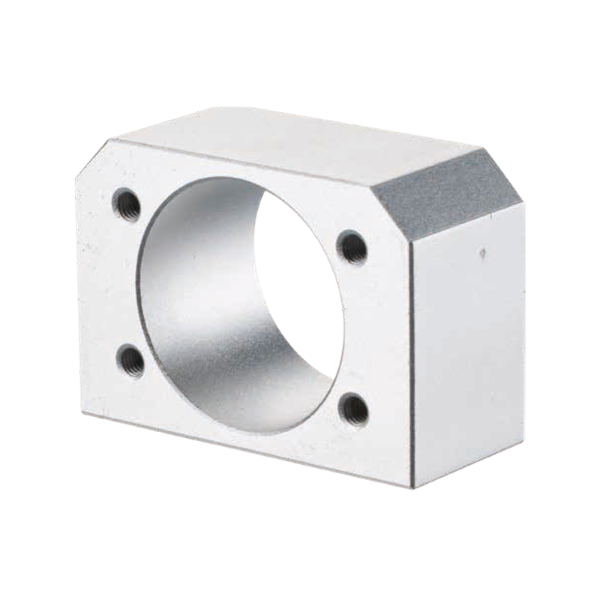
A housing with real structural stiffness keeps that path steady. Forces generated during movement can travel from the Ball Nut Housing into the connected structure without stirring up extra structural motion along the way. That doesn't mean every application needs an unusually stiff design bolted on regardless of cost — the housing simply needs to match the loads and movement pattern the whole machine is actually built around.
A softer housing behaves differently under the same conditions. As loads shift, it can move slightly relative to the parts around it, and that small shift changes how the nut responds to the turning screw. The outcome tends to be a motion pattern that feels less consistent, especially in machines that reverse direction often or that accelerate and decelerate over and over through a work cycle.
The effect gets harder to ignore once several parts start working together. A ballscrew, a guide, a mounting plate, and the machine frame form one connected chain, and if any single link in that chain flexes more than it should, the behavior of the whole assembly shifts with it. Picture the sequence in practical terms: the screw generates the drive, the nut picks that movement up, the housing carries the resulting forces into the machine structure, the frame reacts to those forces, and the structure sends some of that reaction back through the assembly. None of those steps happens in isolation, which is exactly why housing design ends up influencing far more than just the nut sitting inside it.
Does a Softer Housing Change Motion Stability?
Motion stability isn't only about whether a machine eventually lands on target. It's also about how smoothly and consistently it gets there, run after run, and housing movement introduces one more variable into that equation. A packaging line that stutters slightly on every reversal, for instance, often traces back to something flexing where it shouldn't rather than anything wrong with the drive itself.
When a Ballscrew Nut Housing carries enough structural support, the nut tends to stay in a fairly consistent relationship with the machine frame. Once the housing starts flexing under load, though, the nut can shift a little as forces change, and while any single shift might be tiny, repeated changes over thousands of cycles tend to add up into behavior that's noticeably less consistent.
This shows up especially in machines that reverse direction often. The force acting on the nut doesn't stay constant — a movement that starts one way can reverse a moment later, which creates a different load condition inside the assembly almost instantly. A housing built with the right rigidity for that pattern can absorb the change in a controlled way. One without enough support tends to react more slowly, or introduces unwanted movement between parts that were supposed to stay connected.
It's also worth remembering that rigidity isn't only about the housing itself. A stiff nut bolted to a flexible mounting plate won't behave the way anyone expects, because the plate becomes the weak link instead. The surrounding structure needs evaluation as part of the same mechanical system, not as a separate concern tackled later.
How the Housing Shapes System Response
System response is really about how a mechanical assembly reacts the moment operating conditions shift — a change in load, a reversal in direction, some interaction with another part of the machine. In a ballscrew system, the housing sits right in the middle of that reaction, connecting the nut to whatever structure supports it.
When the housing stays stable, force changes pass through the assembly with relatively little extra structural movement. When it bends or shifts instead, some of that movement gets absorbed by the housing and its connection points rather than translating cleanly into the intended motion. The machine can end up feeling less direct to operate, even while it still technically reaches the position it was told to reach — the relationship between input and mechanical response just gets a little muddier.
Rigidity also affects how quickly the system settles after something changes. A softer structure can keep moving slightly even after the driving force has already shifted, almost like a diving board still bouncing after the diver has left it. That behavior isn't automatically a flaw in every application, but it matters a lot in machines that need controlled, repeatable motion — a coordinate measuring setup or a precision dispensing head, for instance, where a little extra settling time translates directly into wasted cycle time.
None of this should get judged from the ballscrew alone. The nut, the housing, the guide arrangement, the mounting structure, and the machine frame all contribute to how the mechanism actually behaves once it's running, and pulling any one of them out of that picture leaves gaps in the analysis.
The Relationship Between Nut Housing and Guide Components
A ballscrew rarely operates by itself. Most linear mechanisms pair it with a guide component that supports and controls the moving assembly, and how the nut housing relates to that guide affects how forces get shared between the two.
A Cylindrical Guide, for example, might handle controlling the movement of a machine element while the ballscrew supplies the driving force. Those two parts play different roles, but they're mechanically connected through the same surrounding structure, so a problem in one tends to echo into the other.
If the housing shifts under load, the relationship between the ballscrew and the guide changes right along with it. The guide can end up carrying forces nobody planned for during the original design work, while the ballscrew nut experiences a load distribution that looks different from what the spec sheet assumed. That's why housing design shouldn't get treated as a decision made in isolation — the mounting position, the surrounding plate, the guide arrangement, and the direction of applied force all play into the outcome together.
Worth thinking through during a design review:
| Design consideration | Why it matters |
|---|---|
| Nut support | Helps control how forces leave the nut |
| Housing connection | Influences structural movement |
| Guide relationship | Affects how forces are shared |
| Mounting structure | Provides the surrounding support |
| Load direction | Changes how the housing is stressed |
| Movement pattern | Influences repeated structural response |
Looking at all of that together gives a much clearer sense of how the assembly will behave once it's doing real work rather than sitting on a test bench.
Why Housing Shape Affects Load Distribution
Shape has its own influence on how forces move through a housing. Load doesn't act on these parts in one clean, single direction — depending on how the machine is built, forces pass through different surfaces and connection points depending on where the assembly is in its cycle.
A housing shape that genuinely matches the surrounding structure helps distribute those forces evenly, cutting down on localized movement and creating a connection that feels balanced rather than lopsided. A poorly matched shape, on the other hand, can concentrate forces around specific mounting points even when the housing material itself is perfectly stiff — the structure around it simply doesn't spread the load the way the design assumed, and movement shows up in spots nobody flagged during early planning.
Shape also has to work within whatever installation space actually exists. Some machines offer plenty of structural support to lean on; others force a compact assembly into a tight corner with little room to spare. A Ball Nut Housing often ends up balancing support, mounting access, nearby components, and available space all at once, and its geometry counts as part of the mechanical interface itself — not just an outer shell wrapped around the nut for looks.
Repeated Movement and Long-Term Behavior
Machines rarely perform a single movement once and stop. They repeat the same motion thousands or millions of times, and that repetition creates a design concern that's genuinely different from thinking about one static load in isolation. The housing and its mounting points experience shifting forces with every cycle the mechanism goes through.
When the structure responds consistently cycle after cycle, motion tends to stay stable over the working life of the machine. When the housing moves differently depending on conditions — heavier load one moment, a direction reversal the next — the mechanical response can drift into something less uniform over time, and that drift is often what shows up later as unexplained wear or a machine that "just doesn't feel as tight as it used to."
Rigidity alone doesn't determine how a system holds up in service. Material choice, mounting quality, the surrounding structure, lubrication, screw condition, and the wider machine design all play a part too. Still, the housing deserves attention because it ties several of those elements together — a stable connection helps maintain a predictable relationship between the screw, the nut, the guide, and the frame, which matters even more on production equipment running long shifts day after day. Reviewing the housing as part of the complete movement system, rather than as one part examined on its own, tends to surface issues that get missed when everything is checked in isolation.
What to Weigh When Choosing a Housing Structure
Housing selection works better when it starts from how the ballscrew system will actually be used, since different machines put very different demands on their mechanical assemblies. A housing built for a compact linear mechanism faces a different set of conditions than one destined for a larger automated system running around the clock.
Load direction deserves early attention, since the direction of force affects how the housing and its mounting points react — both the normal direction of movement and whatever changes happen during actual operation. The surrounding structure matters just as much, because a housing can't make up for a weak plate, frame, or bracket connected to it; overall rigidity comes from that whole chain, not the housing by itself. Guide arrangement plays into the decision too, since the location and type of guide components shape how forces get distributed, and the housing needs to work with that guide system rather than fight it for the same movement path.
Installation conditions bring their own constraints, since space limitations can shape housing geometry and mounting options, and a workable design has to provide enough structural support while still fitting whatever space the machine actually offers. Repeated movement over the working life of the machine deserves consideration too — a design that performs fine under a single test load might behave differently once it's cycling continuously through real production. Maintenance access rounds out the list, since a housing also needs to support practical service work; access to connected components shapes its geometry and installation method, and a structurally sound design should still let a technician actually reach and inspect the surrounding assembly without a fight.
Taken together, these considerations turn housing selection into something closer to a piece of the overall mechanical architecture rather than a simple parts purchase made after the fact.
Bringing Rigidity Into the Bigger Picture
The value of housing rigidity comes into focus once the whole ballscrew assembly gets viewed as one connected system rather than a pile of separate parts. The screw generates movement, the nut receives and passes that movement along, the housing connects the nut to the machine structure, guides control the surrounding motion, and the frame provides the support path underneath everything.
A Lead Screw Nut Housing can serve a related structural purpose in a different type of linear mechanism, which says something about why the interface between a moving element and its supporting structure deserves this level of attention regardless of which screw type sits behind it. When that interface stays stable, designers keep more control over how movement and force actually travel through the assembly rather than guessing after the fact.
This way of thinking can also change how manufacturers organize complete product systems. Rather than selecting a nut and dealing with the housing afterward, designers can plan the housing, guide, mounting plate, and frame as a connected assembly from the outset. This can improve communication between component suppliers, machine builders, and production teams, giving each group a clearer view of how individual parts fit into the wider structure rather than relying on assumptions.
Practical design reviews benefit from asking where the operating load enters the housing and where it leaves again, which surrounding component actually supports the housing, whether the mounting structure could move under changing loads, how the guide system shares mechanical forces, what happens the instant movement direction changes, and whether the housing still allows for maintenance and installation without extra hassle. Questions like these tie housing design back to real machine behavior and help push back against the common assumption that the ballscrew alone decides how the whole system moves.
As linear motion systems keep turning up in more varied equipment, housing design keeps getting more tied to how machines manage force and movement together. Rigidity in a housing was never really about making one part stronger for its own sake — it's about building a stable mechanical path between the moving nut and the structure surrounding it, a path that stays active through every single movement cycle the machine performs. The housing carries forces, works alongside guide components, supports the nut, and helps the rest of the structure respond when motion changes. Treated as an active part of the system rather than a passive bracket, housing selection becomes a genuinely meaningful stage of machine development rather than a box checked near the end of the process.
keep
in touch.
in touch.
-

Address: No.186 Xianglong Road, Lishui City, 323000 Zhejiang, China
-

E-Mail: lydia@wangong.net
-

Tel: +86-13666550158
Copyright © 2026 Lishui Wangong Precision Machinery Co., Ltd.

Ball Screw Manufacturer